


Run the clock, not the kilometres: How to pace and fuel trail runs by time

What you'll learn:
- Why your road pace means nothing on the trails
- The simple rule that reveals a route's true size
- When walking beats running (and saves your legs)
- The best and worst moments to fuel on a hilly run
You know the run. You pick a 15km trail loop, figure it'll take about an hour and a half, because that's what it normally takes, so you head out with a gel in your pocket and a rough finish time in your head.
Ninety minutes later you're nowhere near home. Your watch says your pace is a minute and a half slower than normal. Your legs are heavier than they should be, your head's gone foggy, and that single gel disappeared an hour ago.
Nothing went wrong with your fitness - you just planned the run using the wrong measurement.
On the road, distance and pace tell you almost everything. On the trails, climbs, mud, roots, stiles and the odd "which way now?" moment all bend the link between kilometres and minutes. The runners who handle trails well have stopped asking "how far?" and started asking "how long?"
It's a lesson I've learned the hard way over several 100-mile trail races and multi-day ultras from the Atacama to the Amazon and the Himalaya. Here's how to use the clock to pace and fuel your trail runs.

When the trail turns skyward, pace shouldn't be the measure
Why distance and pace lie on the trails
A kilometre of tarmac is roughly the same every time. A kilometre of trail can be anything from a fast, slightly downhill forest track to a steep, rocky scramble you're hiking with your hands on your knees. Same distance, wildly different time and effort.
The biggest factor is climbing. Every metre you go up costs you time and energy, and the steeper it gets, the more your pace collapses. Descents give some of that time back, but never all of it, especially on technical ground where you can't just let go.
So your road pace is close to meaningless out there. A better guide is a rule of thumb the International Trail Running Association (ITRA) uses to rate races: add 1km for every 100m of climbing. A 20km run with 800m of ascent is closer to a 28km effort. It isn't perfect, but it's a far better starting point than the raw distance.
Pace by effort, not by pace
If pace is unreliable, go by effort. Your body doesn't care whether you're doing 5:00/km on the flat or 12:00/km up a 20% climb, only how hard it's working. For most long trail runs, that means staying at an effort where you can still talk in short sentences, or around 5 to 6 out of 10, and only nudging higher on the climbs.
Hike the hills (it isn't cheating)
On steep climbs, a strong power-hike is often as fast as running at a fraction of the cost. If your stride has shrunk to a shuffle and your breathing is ragged, try hiking. If you're barely losing time, keep hiking. Your legs will thank you in the last hour.

Downhills boost the average speed, but they also smash the quads!
Descents: free speed, with a bill attached
Take some of the free speed on runnable downhills, but hard descending hammers your quads and the damage builds up. Stay relaxed, keep your feet light and hold something back early. If you get sore quads, our piece on running durability is worth a read.
Fuel by the clock
Your body burns energy per hour of work, not per kilometre. A slow, hilly trail kilometre can take twice as long as a road one, so it needs more fuel, not less. Yet most runners carry what they'd take for the same distance on the road.
Start early, then set a timer
Don't wait until you feel flat. For anything over about 90 minutes, start fuelling within the first 30 to 45 minutes. Then set a repeating watch alert, every 30 to 40 minutes is a good start, and take something each time it goes off. It stops you forgetting when you're concentrating on the ground.
Eat on the climbs, not the descents
Fuelling on a fast descent is genuinely hard. You're moving at your quickest, your eyes need to be on your feet and your stomach is getting bounced around. Climbs are the opposite: you're slower, breathing more steadily and have a free hand. So fuel on the climbs and flats, top up at the summit before a long descent, and if your alert goes off mid-descent, wait until the ground eases.

Utilise slower paces uphill to get the calories in
On longer runs, carry a couple of options so you keep wanting to eat (more on this picnic approach here). And apply the same clock logic to fluids: know where you can refill, sip little and often, and replace salts as well as water on warm days.
Make fuelling so easy you actually do it
The best plan fails if eating is a hassle. Cold fingers, poles, a pack you have to take off, a wrapper that won't tear: every bit of friction makes it more likely you'll skip it. So keep fuel in your front vest pockets, choose something you can manage one-handed, and pack out every wrapper.
This is why I've moved more and more of my own long-run fuelling into a soft flask. Prep it at home, keep it in a front pocket and sip without breaking stride. No tearing, no sticky fingers, no wrappers.
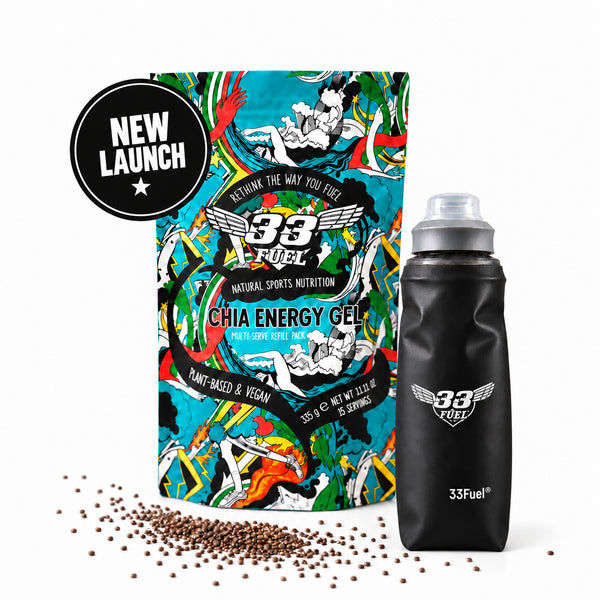
It's exactly why we created Chia Energy Gel Multiserve: the same Chia Energy Gel in a 15-serving pouch. Scoop up to three servings into our Chia Flask, add water, shake and it's ready in ten minutes. It keeps for 24 hours, so you can prep it the night before.

Fuel your next trail run with Chia Energy Gel Multiserve
Three servings fill one Chia Flask for 300 calories of natural, UPF-free energy you can sip without breaking stride. New to Multiserve? Start with the Starter Pack, which includes the Chia Flask.
More performance boosting content
From the YouTube Channel
From the Blog
Endurance durability - 7 ways to get stronger
Creatine for runners, cyclists and triathletes