


Endurance Durability: 7 Ways to Finish Stronger

Why do some endurance athletes fade less than others? The latest endurance research may have an answer
What you'll learn:
- What endurance durability is
- Why fresh fitness only tells half the story
- Why pace, power and efficiency can unravel as fatigue builds
- Seven practical ways to resist the fade and finish stronger
Fresh legs are brilliant liars. They make the opening kilometres feel free, convince you that today is definitely "the day" and they encourage you to ignore the pacing plan written by the more sensible version of yourself.
Then fatigue arrives - pace slips, power drops, heart rate climbs and the person you passed with great confidence an hour ago sails back past looking irritatingly comfortable.
For years, endurance performance was largely explained through three familiar measures:
- VO2 max - how large your engine is
- Threshold - how much of it you can use
- Economy - how efficiently you turn energy into speed
The problem is that these measurements are normally taken while an athlete is rested. Races are rarely decided while anybody is rested.

When you can run long with good form and little deterioration, you've nailed durability
That missing piece is endurance durability, also called physiological resilience or fatigue resistance. It is one of the hottest topics in endurance science, and it may explain why the athlete who looks strongest in the laboratory is not always the athlete who finishes strongest on the road, trail or bike.
What is endurance durability?
Endurance durability is your ability to resist the deterioration in performance and physiology that occurs during prolonged exercise. Put more simply: endurance is how long you can keep going; durability is how little you slow down while doing it.
Two runners could record almost identical VO2 max, threshold and running-economy results when fresh. After 30 kilometres, however, one might still be moving efficiently while the other's oxygen cost has risen, threshold has shifted and stride has started resembling a negotiation with gravity.
The same applies elsewhere. A cyclist may produce impressive fresh power but lose far more of it after riding 100km. A triathlete may ride brilliantly and then discover their running legs have been replaced by two reluctant baguettes. The durable athlete preserves more of their original capacity after work has accumulated.
Researchers have therefore described physiological resilience as a possible “fourth dimension” of endurance performance, sitting alongside VO2 max, threshold and economy. A 2025 review of endurance durability also concluded that traditional fresh-state testing can miss meaningful deterioration during prolonged exercise.

Better durability will allow you to climb stronger later in a race
Why endurance durability matters
Most endurance events are exercises in controlled decline. Everyone becomes tired; the result often comes down to who loses the least speed, power, efficiency and composure.
Poor durability does not always produce one dramatic explosion. It can appear as a slow leak: your normal pace requires a higher heart rate, technique becomes less economical, hills demand more effort and fuelling decisions become increasingly philosophical. By the final third, you are working harder to go slower.
Better durability means delaying that deterioration and reducing its size. It matters in marathons, ultras, long-distance triathlons and sportives, but it also counts in shorter events where accumulated intensity changes what you can produce near the finish.
Durability is not one isolated system. It reflects aerobic conditioning, muscular resilience, neuromuscular function, pacing, fuelling, hydration, heat tolerance and the specific demands of your event. That is excellent news, because it gives us more than one lever to pull.
How can you measure endurance durability?
There is not yet one universally accepted field test for endurance durability. Scientists use different protocols and track changes in variables such as running economy, threshold, critical power and time-trial performance after a fixed amount of prior work.

VO2 can be tested in a lab, but durability will have a greater overall impact on your endurance performance
Outside a laboratory, keep it simple. On a repeatable steady long session, compare the opening third with the final third:
- Can you maintain a similar pace or power for the same perceived effort?
- Does heart rate rise substantially while pace or power stays unchanged?
- Does cadence, technique or posture deteriorate?
- Can you still produce controlled race-pace work near the end?
- How quickly are you recovering in the hours and days afterwards?
Record the route, conditions, fuelling and training load around the session. Heat, hills, dehydration, wind and yesterday's hero workout can all make your durability appear worse than it is. Look for patterns across several comparable sessions, not a verdict from one bad Sunday.
How to build endurance durability: 7 practical strategies
1. Build consistent aerobic volume
Durability begins with enough ordinary endurance training. Easy, consistent volume builds the aerobic machinery, connective-tissue tolerance and movement efficiency needed to keep working when the session stops feeling fresh.
Recent research compared performance-matched male runners who regularly completed runs of at least 90 minutes with runners whose sessions stayed below 70 minutes. After a 90-minute test, running economy had deteriorated by 3.1% in the long-run group and 6% in the shorter-training group.

Keep banking those weekly long runs - they're building durability
Longer weekly runs and greater training volume were both associated with better durability, although the study was observational and cannot prove that simply adding miles caused the difference. Read the study.
The practical message is not to launch your weekly mileage into orbit. Increase training progressively, keep most of it genuinely manageable and give your body time to absorb it. Consistency builds durability; heroic three-week blocks followed by injury build an impressive collection of unused race entries.
2. Make some long sessions race-specific
Slow long sessions establish the base, but your body also needs occasional practice holding useful pace or power after fatigue has started accumulating. That might mean a controlled marathon-pace block late in a long run, a sustained climb near the end of a ride or a short race-pace run after a steady bike.
The key word is occasional. A long run with a strong finish can be a valuable durability session once you have the base to tolerate it. Turning every weekend into the Hunger Games usually leaves you too tired to train properly for the rest of the week.
Start modestly. A runner could finish an otherwise easy long run with two or three controlled ten-minute blocks around target race effort. A cyclist might include similar blocks after a couple of steady hours. Build the duration gradually and stop while your technique is still intact.
3. Add strength and plyometric training

Box jumps are a great plyometric exercise to build durability
Strong muscles do not only produce more force. They can help you maintain economical movement after thousands of repeated strides or pedal revolutions.
In a 2025 randomised trial, 28 well-trained male runners either continued running alone or added two weekly strength and plyometric sessions for ten weeks. The strength group improved running economy after 90 minutes and increased time to exhaustion during the hard effort that followed by 35%, while the running-only group declined by 8%. It was a small, male-only study, but the findings offer unusually direct evidence that strength work can improve running durability. Read the study summary.
For most endurance athletes, two well-programmed sessions per week are enough. Prioritise high-quality squats, split squats, hinges, calf work and sensible plyometrics rather than trying to crawl out of the gym beneath a cloud of chalk every time.
4. Practise fuelling before the wheels come off
Durability and fuelling are not the same thing, but it is remarkably difficult to display your hard-earned fatigue resistance after running low on carbohydrate. If your energy supply collapses, your pace and power tend to follow it down the stairs.
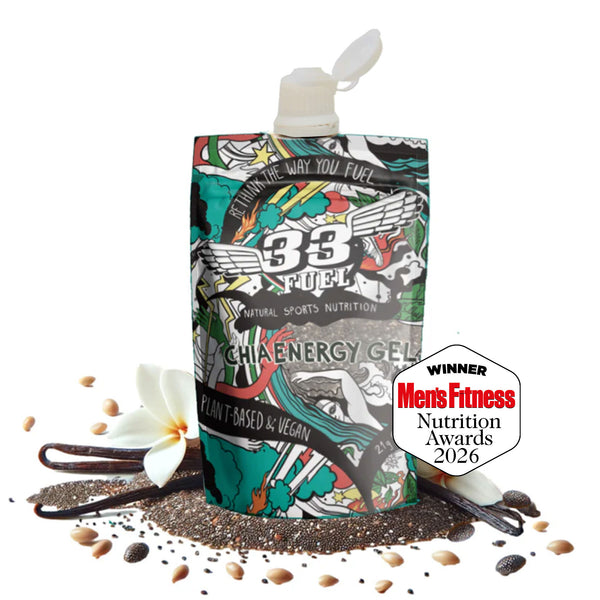
Practise your race nutrition during long sessions, starting early rather than waiting for hunger or the first wobble. Your requirements depend on duration, intensity, body size and tolerance, so build a strategy you can actually digest. Rocket Fuel Carb Drink lets you tailor each bottle from 25g to 100g carbs, while Chia Energy Gel supplies 100 real-food calories in a natural hydrogel.

Unlike most energy gels, Chia Energy Gels contain plant protein alongside carbohydrate - helping give recovery a head start during longer training sessions
Chia is also unusual among energy gels because it contains plant protein alongside carbohydrate. Research reviewed by the International Society of Sports Nutrition reports that adding protein to carbohydrate during exhaustive endurance exercise can reduce markers of muscle damage and perceived soreness afterwards. Each Chia gel provides 2.3g of plant protein, giving recovery a head start while you are still moving. Our guide to protein during exercise and DOMS explains the evidence in full.
5. Pace the athlete you are today
Going too hard early does not prove fitness. It simply brings forward the point at which your physiology begins to deteriorate. Research suggests that higher exercise intensities generally produce earlier and larger losses in durability, which will surprise nobody who has attacked the first climb of a sportive as if the finish line were at the summit.
Settle into an effort you can support, especially when conditions are hot, hilly or unfamiliar. In races, judge the opening section against the whole task ahead, not against the adrenaline currently shouting through your ears. A slightly conservative first third gives your durability a chance to become an advantage later.
6. Train for the fatigue your event creates
Durability is specific. Flat road running does not fully prepare your quads for a mountain race full of descents, just as smooth indoor riding cannot reproduce every muscular and handling demand of five hours outside. Your training should gradually resemble the duration, terrain, transitions and environmental conditions you expect on race day.

Building towards a hilly trail race? Train on terrain as similar to race day as possible
This does not mean recreating the entire race every weekend. Use smaller, recoverable doses: downhill running for eccentric strength, sustained climbs for muscular endurance, brick sessions for triathlon and planned training in warmer conditions where heat is likely. Specific preparation makes late-race fatigue familiar rather than a nasty surprise with its own postcode.
7. Recover well enough to repeat the work
Durability is built between sessions as well as during them. The best programme is useless if you are too depleted to complete it consistently, and repeatedly stacking fatigue without adaptation eventually creates a different kind of durability test: how long you can ignore every warning sign.
After demanding endurance work, replace fluid and carbohydrate, then get enough protein across the day to support muscle repair and adaptation. Premium Protein provides 30g of complete plant protein per serving without artificial sweeteners or UPF extras, making it an easy post-training option when a full meal is not immediately practical.
Sleep and easy days matter just as much. Progress comes from applying stress, recovering and returning able to train again. Skip the middle step often enough and your late-race fade may simply begin before the race has started.

With a whopping 30g protein per serving, Premium Protein is your perfect recovery partner
A simple endurance durability session
Experienced athletes can introduce a controlled “work after work” session every two or three weeks during the specific phase before an event:
- Complete 60–90 minutes of easy running or around two hours of steady cycling.
- Add 2–3 x 10 minutes around your target long-distance race effort.
- Recover easily for 3–5 minutes between blocks.
- Finish if your technique breaks down or the effort rises well beyond control.
- Record pace or power, heart rate, perceived effort, conditions and fuelling.
This should feel purposeful, not apocalyptic. Newer athletes should first build consistent easy volume, while experienced marathoners, cyclists and triathletes can extend or adapt the session to match their event. Never introduce a large dose of late-session intensity close to race day or on top of an already overloaded week.
Frequently asked questions about endurance durability
Is endurance durability the same as stamina?
They overlap, but durability is more specific. Stamina broadly describes your ability to continue exercising; endurance durability describes how well your performance and key physiological qualities are preserved as prolonged exercise accumulates.
Can beginners train endurance durability?
Yes, but beginners rarely need complicated fatigued-state workouts. Consistent easy training, gradually longer sessions, sensible strength work and adequate recovery will build durability without forcing hard efforts onto already tired legs.
Are long runs the best way to improve running durability?
Regular long runs appear to be important, but they are not the only ingredient. Overall training consistency, strength, race-specific work, pacing, fuelling and recovery all influence how strongly you perform when tired.
How quickly can endurance durability improve?
There is no universal timetable because durability depends on your training history, event demands and the quality being measured. One study found meaningful improvements after ten weeks of supplementary strength training, while aerobic and tissue adaptations generally reward months of consistent work.
Does fuelling improve endurance durability?
Fuelling helps preserve the performance you have trained by supplying carbohydrate, fluid and electrolytes during prolonged exercise. It cannot replace durability training, but poor fuelling can hide your fitness beneath an entirely avoidable late-race collapse.
The bottom line: train to finish, not just to start
VO2 max, threshold and economy still matter. But a great score while rested cannot tell you everything about what happens after two hours of hills, headwind, missed bottles and increasingly questionable life choices.
Endurance durability fills that gap. Build your aerobic volume patiently, include carefully controlled work under fatigue, get stronger, practise your fuelling, pace intelligently, prepare for the actual event and recover properly afterwards.
The goal is not to avoid fatigue. That would make endurance sport considerably easier and far less interesting. The goal is to remain capable when fatigue arrives, because the athlete who slows down least is often the athlete who finishes fastest.

Ultimately, better durability will allow you to spend more time doing what you love - why WOULDN'T you want that?!
More performance boosting content
From the YouTube Channel
From the Blog
How to lose fat without losing muscle
Creatine for runners, cyclists and triathletes
Target belly fat (sustainably)
How to (and why you should) improve your grip strength
Research referenced
-
Maunder E, Seiler S, Mildenhall MJ, Kilding AE, Plews DJ. The Importance of 'Durability' in the Physiological Profiling of Endurance Athletes. Sports Medicine, 2021.
-
Jones AM. The Fourth Dimension: Physiological Resilience as an Independent Determinant of Endurance Exercise Performance. The Journal of Physiology, 2024.
-
Hunter B et al. Durability as an Index of Endurance Exercise Performance. Experimental Physiology, 2025.
-
Zanini M et al. Strength Training Improves Running Economy Durability and Fatigued High-Intensity Performance in Well-Trained Male Runners. Medicine & Science in Sports & Exercise, 2025.
-
Zanini M, Folland JP, Blagrove RC. Regular Long Runs and Higher Training Volumes Are Associated with Better Running Economy Durability. Medicine & Science in Sports & Exercise, 2026.
-
Jäger R et al. International Society of Sports Nutrition Position Stand: Protein and Exercise. Journal of the International Society of Sports Nutrition, 2017.